June 30, 2026
Understanding Disability Pride Month
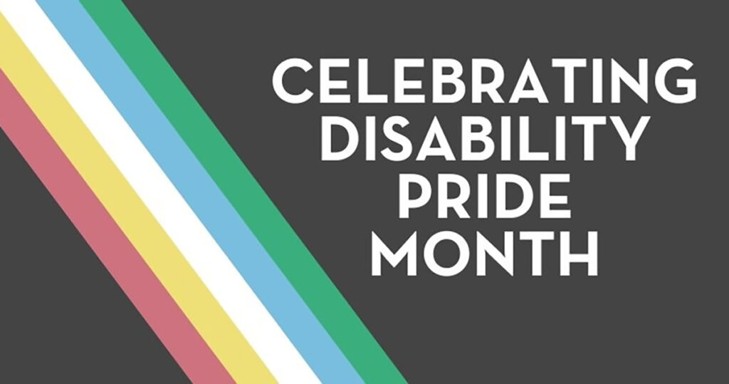
Every July, Disability Pride Month honors the history, achievements, experiences and struggles of the disability community. The timing is intentional: July marks the anniversary of the Americans with Disabilities Act (ADA), the landmark legislation that broke down barriers and changed lives across the country.
This year’s theme is “The World Works Better with Us.” When people with disabilities have a real seat at the table, when they’re respected, supported and genuinely part of the community, things don’t just become more equitable. They become more creative, more resilient and more human. That’s not an aspiration. It’s what belonging actually looks like in practice.
Disability Pride Month was officially established in July 2015, on the 25th anniversary of the ADA, with parades, festivals, educational events and advocacy activities springing up in cities nationwide. For many, it’s also a grassroots movement that challenges systemic ableism and the widespread stigmatization of disability.
People with disabilities are the largest and most diverse minority in the U.S., representing all abilities, ages, races, ethnicities, religions and socioeconomic backgrounds. According to the CDC, one in four Americans has a disability. Worldwide, about one billion people, 15% of the global population, live with a disability. Despite how common disability is, stigma remains widespread.
What is the ADA?
The Americans with Disabilities Act (ADA) protects people with disabilities from discrimination. Signed into law on July 26, 1990 by President George H.W. Bush, it’s commemorated each year as National Disability Independence Day.
The ADA requires employers to provide equal opportunities and benefits to people with disabilities, and prohibits companies from refusing to hire someone based on a perceived or actual disability. It also protects people with a history of disability, such as someone whose cancer is in remission, and requires employers to offer reasonable accommodations.
Modeled on civil rights laws prohibiting discrimination based on race, sex, color, age, national origin or religion, the ADA guarantees Americans with disabilities the right to equal opportunity. In 2008, Congress passed the ADA Amendments Act to broaden how courts interpreted the definition of disability, shifting focus away from defining disability itself and toward whether discrimination actually occurred. The ADA has since become a global model for disability rights.
 The diversity of disabilities
Like all communities, the disability community is not a monolith. It spans a wide range of needs, experiences and perspectives and disability itself can be visible or invisible.
Mental health disorders are the most prevalent category of disability in the U.S. Some people with physical disabilities have some control over how visible their disability is. The same is true across many conditions: autoimmune disorders, developmental differences, long COVID, migraines, anxiety, depression, PTSD, heart disease, IBS, epilepsy, learning differences and differences in neurological functioning and sensory perception.
Find disability resources at the UW
The UW offers a range of resources to support employees and students with disabilities – whether you’re looking for community, accommodations or accessibility tools.
The UW Disability Faculty and Staff Association (DSFA) honors disability as an important part of the UW’s diversity and welcomes faculty and staff who identify as disabled or as allies. The UW Disability Services Office offers information and resources on accessibility, accommodations, parking, ergonomics and more. works to increase the accessibility of technology developed, procured and used across the UW.
The UW Student Disability Commission (SDC) is a student-run advocacy organization committed to serving students, staff and faculty with disabilities at UW. The SDC understands disability not as an individual or medical problem, but as the result of attitudinal and physical barriers that prevent full participation in society.
There is also the University of Washington’s DO-IT Center. They help people with disabilities succeed in school and careers especially in STEM fields. They offer mentoring resources and training to students educators and employers to make learning and workplaces more accessible. Their programs help build more inclusive opportunities for everyone.
How to celebrate Disability Pride Month
No matter who you are – a person with a disability, a family member, educator, employer or neighbor – there’s a place for you in this. Here are some real, practical ways to show up.
Connect with people with disabilities
Start with curiosity and openness. Spend time with people with disabilities in your life at events, at work, at school and online. Listen more than you talk.
- Seek out disability-led stories in the news, like these features from the New York Times, USA Today and PBS NewsHour.
- In everyday life? Just say hi. Visibility and respect are where real connection begins.
Learn disability history and culture
Disability Pride has roots – deep ones. Take some time this month to learn about the movement and the people who shaped it.
- Explore key moments in disability rights history through UC Berkeley’s archive and The Arc’s history.
- Watch Crip Camp, CODA, Demystifying Disability or Disability Visibility for perspectives that are honest, varied and often surprising.
- Follow people with disabilities on social media. There’s a rich, vibrant community out there and a lot to learn from it.
Support
Through the UWCFD, you can support nonprofit organizations that center disabled people and the causes that matter to them. Make a one-time gift or set up an ongoing payroll deduction by searching for a charity by name or cause. Don’t see the organization you’re looking for? Reach out at uwcfd@uw.edu and we’ll work to get them added.
Your gift makes a difference.